Tuesday, 4 September 2018

Finland and Forests


A diary of my Archnetwork visit to Tampere, an Erasmus+ funded trip with host partner Tampere University of Applied Sciences (TAMK).

Day One: Visit to Seitseminen National Park

The group visited Seitseminen National Park, north of Tampere in the Pirkanmaa Region of Finland. Designated a National Park in 1982 and managed by the Finnish Forest Service Metsahallitus Forststyrelsen, the National Park receives 45,000 visitors each year - and the visitor numbers are on the increase.

The National Park is an example of old-growth Finnish forest and showcases how people used to make a living in these remote backwoods. This includes a full-scale 1930's farm stead at Kovero.


We walked the Multiharju Old-growth Forest Trail (1.8 km), amidst the Scots pines, spruces and large aspens, and a multitude of fungi. All uniformly structured, gun-barrel straight specimens unlike the 'Granny Pines' indicative of the Caledonian Forest, at sites such as Rothiemurchus Forest and Abernethy Nature Reserve.


I saw both great spotted woodpecker (Dendrocopos major) and lesser spotted woodpecker (Dendrocopos major).

From Kirkas-Soljanen we walked 2.5 km to Liesilammi Lake and surrounding wetlands to look for signs of beaver. We weren't disappointed!


Day Two: Visit to Avohakkuukohde

We joined second year Forestry degree students from Tampere University of Applied Sciences (TAMK) on a course assignment - mensuration [akin to a Forestry Commission Scotland Forestry for Non-Foresters course I've been on].

The 70-80 year old forest is owned by a variety of private owners, including Tampere City Council. Dr Jenni Kokkarinen, lecturer at Tampere University of Applied Sciences gave us an introduction to forestry practices in Finland. To all intent and purposes Finland's timber industry features four main tree species - Norway spruce (Picea abies), Scots pine (Pinus sylvestris), silver birch (Betula pendula) and aspen (Populus tremula).


From a distance commercial forestry appears less regulated than in the UK. The majority of forests are the Programme for the Endorsement of Forest Certification (PEFC) certified, very few are the more stringent Forest Stewardship Council Certification (FSC) standard. The mixed stands are typically thinned after 40 years before clear-felling after 60-80 years, even as long as 100 years. After clear-fell, Finnish law states the site must be restocked; more often than not this is through natural regeneration, but occasionally Norway spruce is planted, especially on good soils. It would appear Norway spruce is the species of choice in Finnish forestry; Sitka spruce, Picea sitchensis is notable by its absence.


Pests and diseases do not seem to be a major concern in Finnish forestry. The large pine weevil, Hylobius abietis, is present and dealt with through similar treatment techniques. Other pathogens include the fungi Heterobasidion annosum on pine and Heterobasidion parviporum on spruce.

The understory of Finnish forests is mightily impressive with a bewildering array of fungi and lichens. Numerous species of wood ant dominate the forest floor and today I saw my first ever narrow-headed ant (Formica exsecta) nest. The narrow-headed ant is a UK Biodiversity Action Plan priority species and listed as endangered in the UK.


Day Three: Visit to Tampereen Luontokoulu Korento and Tampere Esker

In the morning the group visited Tampereen Luontokoulu Korento (Tampere Nature School) where we met with Biology Teacher, Eva Mantyvaata. The Tampereen Luontokoulu Korento is the only nature school in the Tampere area [there are approximately 30 nature schools in Finland]. Every school in the Tampere area is invited to attend the nature school and children from kindergarten age to 7th Grade (13 years old) are entitled to attend free of charge. Indeed, many of the schools use public transport to travel to the nature school as there is a bus stop immediately outside the school. School groups attend five days a week, all year round.


The demand for the school's services is high. Eva remarked, "The main reason for the demand is that urban teachers don't have the courage to take students outside. We hope to show teachers how easy it is to undertake these activities themselves, and how much fun it is." I was dismayed to discover that even in Finland educators, such as Eva, are beginning to notice children are becoming more and more disconnected from nature. Nature-deficit disorder in Finland - surely not!

In the afternoon, we met up with Dr Eveliina Asikainen, Senior Lecturer at Tampere University of Applied Sciences (TAMK) on Tampere esker. The esker houses an 8,000 year-old forest sympathetically managed by Tampere City Council. Where possible, the council try to manage recreational forests in as natural manner as possible, with no large man-made clearings. As Eveliina says, "Finns don't want parks, we much prefer forests." Perhaps not an unsurprising viewpoint from a resident of the most forested country in Europe.


Day Four: Tampere University of Applied Sciences

The group visited Tampere University of Applied Sciences where Senior Lecturer, Dr Eveliina Asikainen introduced aspects of the Finnish education system.

Children attend school at 7 years old and then spend 9 years in basic education. At age 16, children choose whether they wish to attend upper secondary education (for 3 years) or vocational education (for 3 years). This results in the vast majority of Finnish children remaining in education, in one form or another, until the age of 19.

The upper secondary education option is the more academic of the two, consisting of a traditional Bachelors Degree in Forestry (3-6 years), potentially followed by Masters Degree and Doctoral Degree. Only two universities in Finland offer the traditional Forestry Degree - the University of Eastern Finland and University of Helsinki.

The vocational education option is less academic and more practical and consists of a Bachelors Degree in Forest Engineering (3.5-4.5 years), potentially followed by a Masters Degree. 25 Universities of Applied Sciences, including Tampere University of Applied Sciences offer the Forest Engineering Degree.

Vocational training in forestry in Finland. [Yellow. Harvester driving and Machinery Operative. Green. Producer of Forest Management Services. Courtesy of Eveliina Asikainen].

The Forest Engineering Degree curriculum from Tampere University of Applied Sciences consists of,

·       Forest Sites and Ecology
·       Basics of Forest Management and Harvesting
·       Forest Nature and Forest Regeneration
·       Wood as Raw Material for Bioeconomy
·       Wood Supply
·       Forests and Society
·       Forest Management Planning
·       Forestry Extension and Interpersonal Skills
·       Forestry Business and Project Know-How
·       Machinery and Logistics or Advanced Management Planning
·       Management and Information Systems

In addition, students must complete practical training (30 credits), a written thesis (15 credits) and free choice studies (5 credits).

Perhaps not surprisingly, Tampere University of Applied Sciences Forest Engineering graduates are highly attractive to employers, with approximately 90% employed within forestry after six months from completion of the course.

The group then received a presentation on Conservation of Forest Biodiversity in Finland from Dr Petri Keto-Tokoi. Petri detailed the conflict between forestry and the nature conservation movement that ignited in the late 1960's as a reaction against intensified forest management and continued through the 1970's and 1980's during a very intensive period of logging, forest road building and forest engineering.

The present government of Finland aims to increase annual felling by 25% to 80 million cubic metres per year (an increase of 15 million cubic metres). These targets have re-ignited several issues of conflict, in particular the increased harvesting targets of industrial roundwood and the impacts this will have on biodiversity and carbon storage.

Finally, the seven members of the Archnetwork group delivered short presentations about our work and the organisations we work for to the second year Forest Engineering students.

Day Five: Visit to Lake Puurijarvi National Park

With a free morning the group ventured into Tampere to potentially visit the world's only Moomin Museum. However some of the group were distracted by Tracon 2018, a cosplay, role-playing and anime event held in Tampere, adjacent to the Moomin Museum. I got to meet Deadpool. Chimichangas anyone?


In the afternoon we met up with our host Eveliina Asikainen who took us to Lake Puurijarvi National Park, one of the most important bird lakes in Finland. The National Park is included in the Natura 200 network as it is a Site of Community Interest (SCI) under the Habitats Directive and a Special Protection Area under the Birds Directive.


We spent late afternoon watching marsh harriers (Circus aeruginosus) patrol the mire in search of prey. I was very fortunate to see a red-backed shrike (Lanius collurio) and a white tailed eagle (Haliaeetus albicilla). All three species were firsts for me.
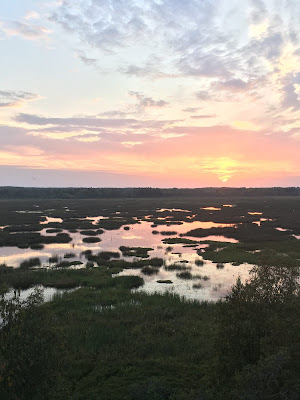

As dusk descended the real spectacle of Lake Puurijarvi revealed itself as more than 1,000 common cranes (Grus grus) returned to the mire in large sieges to rest and roost. A truly unforgettable experience.

Day Six: Visit to Lakkasuo Mire

The group visited Lakkasuo Mire, one of the principal study areas of the research project SUOSILMU (Carbon Cycling and Peatlands and Climate Change) with our host for the day, Dr Pirjo Puustjarvi. The mire receives considerable amount of groundwater from the Vatiharju esker to the west of the mire. Numerous mire site demonstration areas have been established with several kilometeres of wooden trails (or duckboards).


Three species dominate the mire habitat; Norway spruce (Picea abies), Scots pine (Pinus sylvestris) and Dwarf birch (Betula nana). Soil composition and water levels govern species dominance and the transition from Norway Spruce on better quality, drier soil to Scots pine and Dwarf birch on wetter soils was particularly obvious.


In the afternoon, we visited the Serlachius Museum in Mantta. The museum, established by Gustaf Adof Serlachius, one of the pioneers of the Finnish paper industry is aptly housed in the former head office of the company. To this day, Metsa Tissue operate a paper mill on the site of Serlachius' mill from 1868.


Tuesday, 18 April 2017

What makes a Professional?

We find ourselves in a dynamic time for forestry. The sector is burgeoning, which brings a heightened public profile and places forestry professionals well and truly in the spotlight, including their behaviour and attitude. So what makes a professional?

The Oxford English Dictionary defines a Professional as:

Professional ► noun a person engaged or qualified in a profession. ■ a person engaged in a specific activity, especially a sport, as a main paid occupation rather than as a pastime. ■ a person competent or skilled in a particular activity.

But a professional is more than a dictionary definition. Professionalism is about attitude and conduct – a moral compass if you like – and one that is becoming ever more prominent in a modern forestry sector. In many ways it’s no longer enough to have skills and knowledge – a professional must also be able to demonstrate that they can apply it ethically to the situations they face.

The sector is supported by its professional body, the Institute of Chartered Foresters. As a professional organisation constituted under a Royal Charter, the Institute sets standards of education, competence and ethics for its members. It places a strong emphasis on the integrity and competence of its members and therefore requires them to conduct themselves in accordance with a Code of Conduct.

The Code should be considered central to the professional life of a forestry professional not only as a source of ethical guidance, but also as a guide to principles of good practice. The six professional and ethical standards that Institute members must abide by are:

  • Act with integrity
  • Always provide a high standard of service
  • Treat others with respect
  • Take responsibility
  • Act in a way that promotes trust in the profession
  • Have regard for sustainability throughout your work 

Of course you don’t need to be a Chartered Forester to abide by these principles but the role of a Chartered Institute is to ensure that its members follow this Code thereby providing assurance to the general public. Most people recognise that to be a chartered member of a professional body means that the individual is subject to scrutiny regarding their behaviour and that failure to maintain standards can result in a disciplinary process. A Chartered Forester is no different, with an obligation to demonstrate a commitment to follow a Code of Conduct and undertake Continuing Professional Development (CPD) activities. Our members' commitment to lifelong learning is a vital element in improving professionalism within our sector. Meaningful CPD should be high quality, challenging and serve as an outlet to improve professional competence.

Members of the Institute of Chartered Foresters may be found working in the private sector, the public sector, non-government bodies and academia. Our members work in every aspect of forestry including forest management, harvesting, operations, policy, research and urban forestry. What all members have in common is their professionalism.

Professionals stand apart because their relationship with their peers, clients and society, in general, is based on implicit trust. This notion of trust crops up time and again when considering professionalism. We believe Chartered Forester status should be a goal for all in the forestry industry who wish parity with other professionals.

Many employers pay membership subscription fees, support staff with time in lieu for chartered status applications and place chartered status at the heart of staff’s personal development plans. It makes perfect business sense. The benefits of employees that have been awarded Chartered Forester status are obvious, and employers are only too happy to trade on this badge of professionalism.

Our most recent membership survey found that nearly two-thirds of respondents (aged 25-34 year old) who had already obtained chartered status earned in excess of £35,000. By comparison, 89% of respondents who were not chartered earned less than £35,000. Chartered status, quite simply, results in an ability to earn more money and faster career progression. Which is perhaps why membership of the Institute of Chartered Foresters is greater than at any point in our 90-year history. Current membership stands in excess of 1,700 members.

Each year the Institute runs workshops to help applicants understand the chartered process. 
Copyright Rich Dyson Photography.

Whatever your role in the sector, if you believe yourself or your staff to be professional then the pursuit of Chartered Forester status is one of the best means to demonstrate this. As Member Services Director for the Institute of Chartered Foresters, my role is to ensure members get the most from their membership and support those individuals who wish to present for chartered status. If I can assist you in any way, then please feel free to contact me.

This blog post originally appeared in the April 2017 (Issue 80) edition of Forestry & Timber News produced by the Confederation of Forest Industries. 

Thursday, 12 March 2015

Revitalising CPD at the Institute of Chartered Foresters

I was thrilled to be asked to present at this year's Membership Excellence conference, #MEMX15. If "Revitalising CPD at the Institute of Chartered Foresters" is of interest to you, then here's a link to my presentation from yesterday.

Huge thanks to Richard and the team at MemberWise for organising such a slick event. For me, one of the plus points of the day was meeting fellow membership professionals and gaining valuable insights and examples of best practice from them.

Revitalising CPD at the Institute of Chartered Foresters

Friday, 5 December 2014

The Professional Learning Iceberg

Members' professionalism, lifelong learning and Continuing Professional Development (CPD) is an integral part of my role as Membership Manager for the Institute of Chartered Foresters. The motivation behind members' CPD is an area that interests me greatly. Earlier this year, I wrote a blog post for the Institute of Chartered Foresters entitled The Top 5 Benefits of CPD.

On Tuesday of this week, I attended the Professional Associations Research Network (PARN) Conference - CPD: Making it Meaningful. I was infinitely impressed by the opening speaker Hilary Lindsay, Vice President of The Institute of Chartered Accountants in England and Wales (ICAEW) and Affiliated Researcher at the Open University, who enthusiastically shared with us her research on CPD and her Career Adaptability Model. It was most illuminating. 

In 2011 Hilary surveyed more than 500 Chartered Accountants and when asked to record the relevance of learning activities in their current role, the Top 5 responses were as follows,

1. Accessing the Internet for information 
2. Doing your job on a regular basis
3. Reading technical material
4. Reading magazines, newspapers and journals 
5. Attending courses, conferences and seminars

However, when the same group were asked to describe learning activities as CPD, the Top 5 responses were as follows,

1. Attending courses, conferences and seminars
2. Reading technical material
3. Reading magazines, newspapers and journals
4. Studying online learning modules
5. Accessing the Internet for information

It would appear many professionals still equate formal learning activities as the premier source of CPD. We, as professional associations have an obligation to our members to communicate and reinforce the importance of informal learning, practical learning and reflection as acceptable, and indeed desirable components of CPD. 

In her presentation, Hilary used models from Illeris (2002) and Livingstone (2002) to illustrate the three dimensions of learning and the informed learning iceberg (see below). The majority of our members will readily undertake cognitive learning activities, whether it be attending formal training courses or reading technical material. 


But as professional associations we need to encourage our members to,

1. Learn with or from others
2. Learn on the job
3. Learn through reflection

Only by embracing these interpersonal and intrapersonal activities (those learning styles submerged in the ocean at the base of the iceberg) will our members be truly competent professionals. 

How best to illustrate this to members of the Institute of Chartered Foresters? The iceberg becomes a tree, obviously. 


You can read more about Hilary Lindsay's research in the PARN publication - Adaptability: The Secret to Lifelong Learning. 

Further reading.
Illeris, K. (2002) The three dimensions of learning. Roskilde University Press.
Livingstone, D. W. (2002) Lifelong learning and underemployment in the knowledge society: A North American perspective. Supporting lifelong learning. Volume 3: Making policy work. The Open University.

Monday, 13 October 2014

I'd like to nominate...

On Tuesday morning, my Twitter timeline was peppered with a series of bleary-eyed celebrity selfies - Jemima Khan, Liam Neeson, Hugh Grant, Jeremy Clarkson, Claudia Winkleman and Tom Hiddleston to name but a few. This was my introduction to Unicef's #WakeUpCall campaign. A campaign designed to highlight the plight of thousands of Syrian children who have fled from the relentless violence in their country. No one could possibly question the aim of the campaign, but immediately something didn't sit right with me. I posted the following tweet,
Somewhat surprisingly, no backlash followed. In fact, I wasn't alone in my questioning of the campaign. Zoe Amar and Charles Bagnall concurred, and Jonathan Waddingham referred me to a Huffington Post article on the very same subject.

To me the #WakeUpCall campaign seemed too contrived and manufactured. It was trying a little too hard if you like. It wanted to be the next #IceBucketChallenge.

As a former fundraiser, I don't feel comfortable publicly belittling a charity's fundraising campaign, but #WakeUpCall really irked me. I felt Dan Snow's #WakeUpCall contribution was one of the most infuriating.
#WakeUpCall suddenly seemed like another narcissistic vehicle for celebrities, their stylists and their PR people. Hadley Freeman's feature in The Guardian distills my discomfort better than I could ever hope to achieve,

"Is this really what we have come to - needing to see photos of luminaries such as Nicky Hilton and Elle Macpherson in bed in order to give money to Unicef? Since when did charity become some kind of beauty pageant in which famous women flaunt their 'natural' looks?"

For some celebrities the act of nominating their 'celebrity mates' is almost as important (and self-gratifying) as the challenge, or indeed the cause itself.

However, the following day the game changed. I received an Instagram notification, Paul De Gregorio had nominated me. The bugger! I found myself with an interesting dilemma - nominated for a fundraising challenge for a campaign that annoyed me, but nominated by someone I respect and admire. Is the act of nominating others set to be the focus of successful fundraising campaigns over the next wee while?

Paul's #WakeUpCall contribution was particularly creative and certainly no narcissistic allegations can be leveled at him.

The eye mask is not a prop. I fear this is Paul's regular slumber attire. Digital Diva!
My discomfort with #WakeUpCall remains. Nonetheless, somewhat hesitantly, in some ways begrudgingly, I'm about to share my own #WakeUpCall contribution. I've made a donation to Unicef and I would urge you to do likewise.

Please text SYRIA to 70007 to give £5.00 to Unicef.
And so to my nominations. I'd like to nominate Sara, Andy and Helen for #WakeUpCall.

Thursday, 6 February 2014

The job interview. A chance to impress a potential donor?

Did you see the recent story from the US about an entry level candidate to an unnamed not-for-profit that had to prepare a meal for 40 senior executives as part of a 12 hour interview process? Only in America?

As someone who has recently experienced the recruitment process I'm pleased to say its not as bad in the UK. It is demanding, and rightly so. Candidates are expected to jump through a bewildering array of hoops to secure that dream job - obligatory presentations, role play exercises, copywriting challenges, staged team lunches. The list goes on. Employers seem to want more and more from the candidate. One role I interviewed for expected the applicant to match 33 Essential skills, but no Desirable skills. Essential skills they defined as the attributes without which a candidate would not be able to undertake the full remit of the role; and applicants that did not clearly demonstrate in their application that they possessed the essential skills would normally be eliminated at the short listing stage. Really? 33 Essential skills.

I experienced first hand a great disparity in the manner charities treated candidates. Several organisations failed to inform me of the interview panel's decision. Others gave cursory feedback. A token gesture to appease the Human Resources Manager.

However, one charity stood out from the crowd. CLIC Sargent. A wonderful charity helping children and young people with cancer. In preparation for an interview I lived on their website, absorbing as much information as I could.

But it was CLIC Sargent's post-interview processes that impressed me. I was interviewed for a fundraising position by two senior fundraising staff. Following the interview I was informed of the panel's decision promptly by email. The member of staff offered a telephone meeting to discuss the interview in-depth. When we spoke, the member of staff went through each interview question one by one, often referencing exact phrases from the interview, in order to provide me with detailed feedback. Valuable, constructive feedback. This did not feel like a box-ticking exercise devised by the Human Resources Manager. Rather, an organisation that appreciated, respected, even valued the candidates that made the effort to present at interview. It struck me that if this is how CLIC Sargent treat an interview candidate, how on earth do they treat their staff?

CLIC Sargent are helping children and young people with cancer through out the UK.
So impressed was I with CLIC Sargent that I'm fundraising for them. This April, myself and group of friends are undertaking the 23 miles from Glasgow to Loch Lomond as part of The Kiltwalk. I'm proud to be taking on this fundraising challenge for CLIC Sargent. You can sponsor us here.

As fundraisers, we're only too aware that every meeting is an opportunity to impress a potential donor; whether its a scheduled face-to-face meeting with a well-researched prospect or a chance encounter at a dinner party. We accept the ambassadorial role for our charities. From these encounters, extraordinary relationships are established and transformational gifts received. But how many of us would treat the job interview as an opportunity to impress a potential donor?

The candidate in front of you may have the propensity to give? The candidate in front of you will most certainly have networks. Those members of staff that undertake interviews on behalf of a charity, remember you're not only interviewing the candidate in front of you. You're being interviewed by them.

Sunday, 26 January 2014

Is this the best thank you letter ever written?

This weekend I received a wonderful thank you letter from Child's i Foundation. Child's i Foundation is an organisation very close to my heart - see The Three Robbers. The thank you letter is exhibits a high level of personalisation and details a degree of donor impact, nonetheless the title of this blog post is a pretty bold claim.

Here's the copy, see what you think.

Dear Stuart,

I just wanted to send you a little something to say thank you for everything you do for Child's i Foundation. It's not just that you believed in us from the beginning, or that you've recently more than doubled your regular gift (for which we are incredibly grateful) or even your unshakable online support. it's you endless commitment and enthusiasm which continues to help our project thrive. You really are changing children's lives - and not just in Uganda. We're committed to growing our successful model, using all experience from the project so far, to help change the lives of more children around the world. Thank you for believing in us and being part of our movement.

Love Teri and Lucy.

I could deconstruct the thank you letter, analyse individual components -
  • It acknowledges the donor's range of support for Child's i Foundation
  • It demonstrates staff know that the donor recently increased a monthly Direct Debit donation
  • It reassures the donor of the impact their donation is making in Uganda (and beyond)
  • It thanks the donor for believing in the organisation
But here's the thing. This isn't an automated, mass produced thank you letter spat out from a customer relationship management database with a series of merged fields to appease the donor's need for authenticity. This is a handwritten note, in a handwritten envelope that has the impudence to address me as "Stuart Glen, Childs i Super Supporter." This is a thank you letter that accompanies a simple piece of artwork from Issa, sent all the way from Uganda.

A thank you note from Child's i Foundation.

I don't know Teri. But I her imagine her taking ten minutes out of her busy day, amidst 101 other things screaming for her attention, to write a thank you note to a Child's i Foundation supporter. It's a letter from one human being to another. That's why I believe this is the best thank you letter ever written.

Fundraisers ask yourself, can you say the same about your suite of thank you letters?

Thursday, 22 August 2013

Life is the ultimate adventure, and death, the prize that awaits us all.

I attended a really interesting seminar this week entitled The Next Generation of Scottish Giving: Planning Your Fundraising Future. The opening presentation from Mike Johnston of Xtraordinary Fundraising shared data from The Next Generation of Giving in the UK report. The report proclaims itself to be a study on the multichannel preferences and charitable habits of Generation Y, Generation X, Baby Boomers and Matures. There's a whole heap of great stuff in there - I'd urge you to read it, if you haven't already done so. The report can be downloaded here.

One area of Mike's presentation that unsurprisingly caught my eye was the attitudes of donors to In Memoriam giving. From the presentation (and the report),

"In the UK, middle-aged donors are less likely than North American middle-aged donors to make a tribute gift - and are not much more likely than young donors to make a tribute gift. By comparison, in North America there is a lifecycle influence on tribute giving. The older you are, the more likely you are to make a tribute gift. Is this a missed opportunity with UK not-for-profits? If you don’t have a tribute gift programme, you may wish to consider starting one. This could be as easy as offering your donors the option of memorial, honour and celebration e-cards and/or cards when they donate."

I couldn't agree more. In my opinion most UK charities are way off the mark when it comes to In Memoriam giving.

Donors are comfortable with In Memoriam giving. Donations in lieu of flowers and funeral collections are increasing month after month. The same report details that 20.1% of donors made a tribute gift in the past 12 months. For many donors In Memoriam giving satisfies a donor need and may in fact play a part in the grieving process itself.

So if donors are comfortable with In Memoriam giving, perhaps it is us - Fundraisers - who have the problem? Do we shy away from the ask in fear of upsetting donors? Talking about death is something most people understandably feel uncomfortable about. Change the focal point - In Memoriam giving is affording donors the opportunity to remember and honour a loved one.

Perhaps the stumbling block is internal? Do we have the conviction to steer the programme past wary Senior Managers or anxious Trustees?

One thing is certain, we're exasperating the problem. Because we don't ask, potential In Memoriam donors don't give. Engaging and sensitive In Memoriam communications can and do, raise funds and those charities that have got it right have created highly motivated donors passionate about the cause so closely associated with a loved one.


What would you prefer? Yellow spandex?


Note to conference speakers. Want to grab your audience's attention? Promise them FREE X-Men tees. That's what Mike Johnston of Xtraordinary Fundraising did. A certain 8 year old Marvel fan was very pleased that I sat in the front row and participated fully. Don't worry - he'll grow into it!

Monday, 15 July 2013

The Three Robbers

This blog post was originally published on Paul de Gregorio's blog on Wednesday 11 January 2012.

With two wee boys – one aged six and the other two – a visit to The Eric Carle Museum of Picture Book Art was top of our to-do list in Massachusetts last summer. It’s refreshing to know that America can deliver attractions like The Eric Carle Museum of Picture Book Art – not all attractions need to be crammed full of rollercoasters and fast food franchises. We spent a magical afternoon at The Eric Carle Museum of Picture Book Art, marvelling at the artwork on display, completing a treasure hunt and taking part in a storytelling session. The unexpected bonus was an additional exhibition of the work of Tomi Ungerer, a French artist, illustrator and author, who’s work until then I was unfamiliar with.


Six year Mackenzie’s personal tribute to the museum scene in Ferris Bueller’s Day Off.

The museum provided me with a magical memory that I will treasure until the day I die. I sat in the Tomi Ungerer exhibition with my two year old on my lap and read to him an exhibition copy of The Three Robbers. First published in 1959, it’s a charming tale of three robbers with tall black hats who use their plundered bounty to buy a castle in order to look after the abandoned children of the land. Exquisitely illustrated, it’s a tale that stands the test of time. The sentiment seeping through the story struck a chord with me as I sat in the museum cuddling my two year old. I immediately thought of the wonderful Child’s i Foundation – a charity extremely close to my heart.

Child’s i Foundation are awesome. Their Baby and Family Centre in Malaika, Uganda provides short-term care for up to 24 at-risk babies; and the tenacious Lucy Buck, the founder of Child’s i Foundation is constant source of inspiration to me. I’ve been fortunate enough to meet Lucy now on a couple of occasions – I invited her to speak at the Institute of Fundraising Scotland Conference 2011 where she delivered an unforgettable and emotionally charged closing plenary. Not a dry eye in the house, or was that just me? Lucy has a penchant for making me cry.

As a thank you to Lucy, I presented her with the copy of The Three Robbers that we bought in the museum. This was a huge wrench for me – this book conjured up images and emotions of a magical moment. Of course, I had to ask both the boys’ permission first. But the charming tale reminded me of Lucy and her amazing journey with Child’s i Foundation.

I know Lucy realised the significance the gift.

When she returned to Uganda I received an email that reduced me tears. Again. It’s a picture of Lucy reading The Three Robbers to one of the children in the Malaika Baby and Family Centre. 

From Lucy’s email, “It is a beautiful book and I must admit I keep it in my office as I don't want the kids to damage it but it is becoming a bit of a favourite!”
Lucy’s email was heartening but on Christmas Eve, Child’s i Foundation delivered a level of personal donor care that I believe can only be demonstrated by a small charity in tune with their donors. On Christmas Eve I received a handmade, hand-written Christmas Card. No design agency was involved. No clever creative or call to action. Instead, a thank you. The card design featured the hand-print of eight month old, Liam [as a parent I know how much fun was had making that hand-print] and inside a hand written message from Lucy. It read,

“Thank you so much for all your support this year and believing in me and Child’s i Foundation… “

My thank you card from Lucy, and Liam!
I’ve done nothing. My £2.50 a month is not going to change the world, but Childs i Foundation make me feel like I’m genuinely making a difference. I believe Childs i Foundation when they say, “The personal contribution of each and every participant makes as they support Child’s i Foundation – whether through time, money or love – is something we recognise and value highly.” I buy this.

The innovation Child’s i Foundation have demonstrated online is well documented. There is a strong community online supporting and advocating their work. But this magical personal touch really does strengthen the bond with their donors. The proof is in the pudding – this evening, I’ve doubled my monthly contribution to Child’s i Foundation. Perhaps Lucy should don a tall black hat?

Monday, 8 July 2013

Ten copywriting lessons fundraisers can learn from Dr Seuss

On the 2nd of March 1904, in Springfield, Massachusetts one of America's finest writers was born. You may not have heard of Theodor Seuss Geisel, but I hope you are familiar with the wonderful writing of Dr Seuss. Over a 53 year period, Dr Seuss published 46 timeless children's books.

With a young family I have loved rediscovering the imagination-bending back catalogue of Dr Seuss. So much so, that on a family vacation to Boston and Cape Cod in 2008, we hired a car and drove the 95 miles to Springfield to visit The Dr Seuss National Memorial Sculpture Garden. Now, I know there is a Seuss Landing at Islands of Adventure in Universal Studios, Orlando, but the afternoon in the serene and peaceful memorial scuplture garden with 11 month old Mackenzie is a memory I'll treasure for the rest of my days.

The Dr Seuss Memorial Sculpture Garden, Springfield, Massachusetts.

Beyond the seemingly nonsensical rhymes a subtle moral lesson frequently lurks in the works of Dr Seuss. Although Geisel made a point of not beginning the writing of any of his stories with a moral in mind because he was adamant that "kids can see a moral coming a mile off." He chose his words carefully, sparingly and  intelligently. He was a brilliant copywriter. One that anyone involved in writing fundraising copy should study and admire. In no particular order, here are 10 fundraising copywriting lessons I've learned from Dr Seuss,

1. Believe in yourself.
"And will you succeed? Yes! You will, indeed! (98 and 3/4 per cent guaranteed.) Kid, you'll move mountains!" Oh, The Places You'll Go!, 1990.
You are clearly the best person to tell this story. When communicating with donors, speak with authority, confidence and self-belief.

2. Be truthful at all times.
"I meant what I said and I said what I meant...An elephant's faithful one hundred per cent!" Horton Hatches The Egg, 1940.
Be honest with donors. Don't fail to deliver on promises made to donors and don't make exaggerated claims. Establishing trust is vital for the relationship to flourish.

3. Be courteous and polite.
"But I'm a good sport, so I'll just let him rest. For a host, above all, must be nice to his guest." Thidwick The Big-Hearted Moose, 1948.
Every touch-point, whether it be a face-to-face encounter with a donor or the administration procedure of the latest Direct Mail appeal is an advertisement for your charity. Make it count. Some people call it stewardship, others donor care. Either way, get the basics right. Is the envelope addressed correctly? With the correct salutation? Will you acknowledge the gift within 24 hours?

4. Speak with passion.
"I speak for the trees, for the trees have no tongues. And I'm asking you, sir at the top of my lungs." The Lorax, 1971.
You have a duty to tell your beneficiary's story - and its a darn site more engaging if the person sharing the story is passionate, powerful and persuasive. When you sit down to write, make sure your 'dander' is up!

5. Expose injustice and inequality.
"I know up on top you are seeing great sights, but down here on the bottom, we too should have rights." Yertle The Turtle, 1958.
Don't forget fundraising basic principles – reveal a strong proposition and offer the donor a simple and clear solution.

6. Never be afraid to try something new.
"Sam! If you will let me be, I will try them. You will see. Sam! I like green eggs and ham! I do! I like them, Sam-I-am!" Green Eggs And Ham, 1960.
Each Direct Mail appeal is an opportunity to test, to refine and to try something different. Use these tests to refine your Direct Mail campaigns.

7. Size doesn't matter.

"Don't give up! I believe in you all! A person's a person, no matter how small!" Horton Hears A Who!, 1954.
No matter how small your organisation is, you can make a difference. No matter how small you are, you can make a difference. Think about it, young children regularly raise ridiculous amounts of money for charity - try telling them that they're too small to make a difference. One of my personal favourites remains Jack Draws Anything.

8. Challenge perceived wisdom.
"There's no limit to how much you'll know, depending how far beyond zebra you go." On Beyond Zebra, 1955.
Floob, Fuddle and Snee. There are 20 twenty letters on beyond Z in the world of Dr Seuss; and you thought the alphabet stopped at Z. Challenge perceived wisdom. Don't settle for 'we've always done it that way.'

9. Let your imagination run riot.

"Stop telling such outlandish tales, stop turning minnows into whales." And To Think That I Saw It On Mulberry Street, 1937.
We've all got a Marco's Dad in our team. Don't listen to people who quash your imagination and creativity - let it run riot. One day, Marco transforms a plain horse and wagon on Mulberry Street "into a story that no one can beat!" That's the sort of Direct Mail appeal your donors want to read.


10. You've got to care.
"Now that you're here, the word of the Lorax seems perfectly clear. Unless some one like you cares a whole awful lot, nothing is going to get better. It's not." The Lorax, 1971.
Whatever the cause, whatever the fight, you can make a difference. But you've got to care. Make it apparent in your fundraising copy.

Wednesday, 26 June 2013

Please accept my deepest condolences

Your charity has received a gift in memory of a loved one from a donor. What is the opening line in your reply letter? The unimaginative 'Please accept my deepest condolences' or the equally bland 'Thank you for your kind donation.' Two completely different openings; neither of them particularly inspiring and each with their own pluses and minuses. Would you say there is a correct response?


A selection of thank you letters
I was fortunate to attend a seminar entitled Engaging bereaved donors last week organised by the Institute of Fundraising (London). Reaffirming, yet informative, the course was delivered by the ever-knowledgeable Kevin Kibble. The opening sentiment of the hypothetical reply letter was discussed and it's fair to say the opening gambit split the delegates 50:50. In the end, I found myself leaning more towards 'Thank you for your kind donation' especially after Kevin remarked, "First and foremost, this is a thank you letter for a donation." Of course, a well-crafted reply letter will offer expression of condolences as well, but later in the letter.

In Memoriam giving is an area of fundraising that interests me more and more. It is also an area of growth. Last month JustGiving reported a 32 per cent increase in In Memoriam donations from January to May compared to the same period last year.

In my opinion, many charities struggle to communicate with In Memoriam donors in a professional, appropriate and empathetic manner. Likewise, the ability to devise In Memoriam products that connect with In Memoriam donors are few and far between. Earlier this year, I posed a question on Twitter "What charities are offering engaging #TributeFund programmes in your opinion?" I received a fantastic response. As you can see, opinion was mixed among respondents.

I'm convinced, more than ever, that medical research and palliative care charities are failing to realise the potential of Tribute Funds. Tribute Funds offer In Memoriam donors the opportunity to create a lasting tribute in memory of a loved one; and for the charity, a product that encourages engagement and commitment from one-time In Memoriam donors. The bereaved want to remember loved ones, not forget.

Friday, 14 June 2013

What's my motivation?

Last week I was invited to speak at a seminar held by New Philanthropy Capital in response to the Money for Good UK report.  The Money for Good UK report, published in March 2013 contains a donor segmentation model based on donor motivations. 

Money for Good UK report
On reading the report I found myself unconsciously referencing my own experience in charities in the fields of conservation, animal rights, hospice and now medical research.

For example, I remembered Loyal Supporters at the animal rights charity – steadfastly driven by the cause, giving in private and occasionally embarrassed to give to their chosen cause. 

Echoes of Benefactors at the hospice – donors keen to publicly show their contribution to their network, usually at a black tie event; but frustratingly with little loyalty to the cause.

Even now, in a new role with a medical research charity the concept of Ad hoc givers resonates with me. These donors with a highly personal connection to the cause are extremely difficult to engage with on a repeated basis. 

Myeloma UK is the only charity in the UK dealing exclusively with myeloma, a complex, debilitating and incurable cancer of the plasma cells. What is interesting about the supporter base at Myeloma UK is the notion that the potential donor base is limited to the patient, their family and their immediate network. Very much following the donor characteristics of an Ad hoc giver.

One question that struck me when reading the report was whether donors could migrate between defined donor segments? Should we as fundraisers be designing programmes to encourage Ad hoc givers to become Loyal Supporters or Engaged Champions? Is this even possible? Are we fighting against fundamental donor instincts? Or should we embrace the donor segments and tailor communications to suit the donors, not us?

There's a wonderful blog post on The Agitator website from last month entitled, "The Foibles and Follies of Donor Conversion." Roger Craver reports on a session from the Engage Conference in the US where one of the speakers challenges the audience, "Why are nonprofits mad at about 50% of their donors at any given time for donating in the "wrong" way? And why do they persist in attempting to convert them to behaving differently?"

What in fact is wrong with the donor that sends a £100 cheque every February? Why should I devise a strategy and insist they move to a £10.00 a month programme?

Indeed, does that Ad hoc giver even perceive themselves to be an Ad hoc giver? Perhaps that Ad hoc giver would see themselves as a Loyal Supporter or Engaged Champion?

I'd recommend spending an hour or two reading the Money for Good UK report and I, for one, am very much looking forward to see how New Philanthropy Capital uses the research and implements its findings to work with charities over the coming months.