A diary of my Archnetwork visit to Tampere, an Erasmus+ funded trip with host partner Tampere University of Applied Sciences (TAMK).
Day One: Visit to Seitseminen National Park
The group visited Seitseminen National Park, north of Tampere in the Pirkanmaa Region of Finland. Designated a National Park in 1982 and managed by the Finnish Forest Service Metsahallitus Forststyrelsen, the National Park receives 45,000 visitors each year - and the visitor numbers are on the increase.
The National Park is an example of old-growth Finnish forest and showcases how people used to make a living in these remote backwoods. This includes a full-scale 1930's farm stead at Kovero.

We walked the Multiharju Old-growth Forest Trail (1.8 km), amidst the Scots pines, spruces and large aspens, and a multitude of fungi. All uniformly structured, gun-barrel straight specimens unlike the 'Granny Pines' indicative of the Caledonian Forest, at sites such as Rothiemurchus Forest and Abernethy Nature Reserve.

I saw both great spotted woodpecker (Dendrocopos major) and lesser spotted woodpecker (Dendrocopos major).
From Kirkas-Soljanen we walked 2.5 km to Liesilammi Lake and surrounding wetlands to look for signs of beaver. We weren't disappointed!

Day Two: Visit to Avohakkuukohde
We joined second year Forestry degree students from Tampere University of Applied Sciences (TAMK) on a course assignment - mensuration [akin to a Forestry Commission Scotland Forestry for Non-Foresters course I've been on].
The 70-80 year old forest is owned by a variety of private owners, including Tampere City Council. Dr Jenni Kokkarinen, lecturer at Tampere University of Applied Sciences gave us an introduction to forestry practices in Finland. To all intent and purposes Finland's timber industry features four main tree species - Norway spruce (Picea abies), Scots pine (Pinus sylvestris), silver birch (Betula pendula) and aspen (Populus tremula).

From a distance commercial forestry appears less regulated than in the UK. The majority of forests are the Programme for the Endorsement of Forest Certification (PEFC) certified, very few are the more stringent Forest Stewardship Council Certification (FSC) standard. The mixed stands are typically thinned after 40 years before clear-felling after 60-80 years, even as long as 100 years. After clear-fell, Finnish law states the site must be restocked; more often than not this is through natural regeneration, but occasionally Norway spruce is planted, especially on good soils. It would appear Norway spruce is the species of choice in Finnish forestry; Sitka spruce, Picea sitchensis is notable by its absence.

Pests and diseases do not seem to be a major concern in Finnish forestry. The large pine weevil, Hylobius abietis, is present and dealt with through similar treatment techniques. Other pathogens include the fungi Heterobasidion annosum on pine and Heterobasidion parviporum on spruce.
The understory of Finnish forests is mightily impressive with a bewildering array of fungi and lichens. Numerous species of wood ant dominate the forest floor and today I saw my first ever narrow-headed ant (Formica exsecta) nest. The narrow-headed ant is a UK Biodiversity Action Plan priority species and listed as endangered in the UK.

Day Three: Visit to Tampereen Luontokoulu Korento and Tampere Esker
In the morning the group visited Tampereen Luontokoulu Korento (Tampere Nature School) where we met with Biology Teacher, Eva Mantyvaata. The Tampereen Luontokoulu Korento is the only nature school in the Tampere area [there are approximately 30 nature schools in Finland]. Every school in the Tampere area is invited to attend the nature school and children from kindergarten age to 7th Grade (13 years old) are entitled to attend free of charge. Indeed, many of the schools use public transport to travel to the nature school as there is a bus stop immediately outside the school. School groups attend five days a week, all year round.

The demand for the school's services is high. Eva remarked, "The main reason for the demand is that urban teachers don't have the courage to take students outside. We hope to show teachers how easy it is to undertake these activities themselves, and how much fun it is." I was dismayed to discover that even in Finland educators, such as Eva, are beginning to notice children are becoming more and more disconnected from nature. Nature-deficit disorder in Finland - surely not!
In the afternoon, we met up with Dr Eveliina Asikainen, Senior Lecturer at Tampere University of Applied Sciences (TAMK) on Tampere esker. The esker houses an 8,000 year-old forest sympathetically managed by Tampere City Council. Where possible, the council try to manage recreational forests in as natural manner as possible, with no large man-made clearings. As Eveliina says, "Finns don't want parks, we much prefer forests." Perhaps not an unsurprising viewpoint from a resident of the most forested country in Europe.

Day Four: Tampere University of Applied Sciences
The group visited Tampere University of Applied Sciences where Senior Lecturer, Dr Eveliina Asikainen introduced aspects of the Finnish education system.
Children attend school at 7 years old and then spend 9 years in basic education. At age 16, children choose whether they wish to attend upper secondary education (for 3 years) or vocational education (for 3 years). This results in the vast majority of Finnish children remaining in education, in one form or another, until the age of 19.
The upper secondary education option is the more academic of the two, consisting of a traditional Bachelors Degree in Forestry (3-6 years), potentially followed by Masters Degree and Doctoral Degree. Only two universities in Finland offer the traditional Forestry Degree - the University of Eastern Finland and University of Helsinki.
The vocational education option is less academic and more practical and consists of a Bachelors Degree in Forest Engineering (3.5-4.5 years), potentially followed by a Masters Degree. 25 Universities of Applied Sciences, including Tampere University of Applied Sciences offer the Forest Engineering Degree.
 |
| Vocational training in forestry in Finland. [Yellow. Harvester driving and Machinery Operative. Green. Producer of Forest Management Services. Courtesy of Eveliina Asikainen]. |
The Forest Engineering Degree curriculum from Tampere University of Applied Sciences consists of,
· Forest Sites and Ecology
· Basics of Forest Management and
Harvesting
· Forest Nature and Forest
Regeneration
· Wood as Raw Material for Bioeconomy
· Wood Supply
· Forests and Society
· Forest Management Planning
· Forestry Extension and Interpersonal
Skills
· Forestry Business and Project
Know-How
· Machinery and Logistics or Advanced
Management Planning
· Management and Information Systems
In
addition, students must complete practical training (30 credits), a written thesis (15 credits) and free choice studies (5 credits).
Perhaps not surprisingly, Tampere University of Applied Sciences Forest Engineering graduates are highly attractive to employers, with approximately 90% employed within forestry after six months from completion of the course.
The group then received a presentation on Conservation of Forest Biodiversity in Finland from Dr Petri Keto-Tokoi. Petri detailed the conflict between forestry and the nature conservation movement that ignited in the late 1960's as a reaction against intensified forest management and continued through the 1970's and 1980's during a very intensive period of logging, forest road building and forest engineering.
The group then received a presentation on Conservation of Forest Biodiversity in Finland from Dr Petri Keto-Tokoi. Petri detailed the conflict between forestry and the nature conservation movement that ignited in the late 1960's as a reaction against intensified forest management and continued through the 1970's and 1980's during a very intensive period of logging, forest road building and forest engineering.
The present government of Finland aims to increase
annual felling by 25% to 80 million cubic metres per year (an increase of 15
million cubic metres). These targets have re-ignited several issues of conflict, in particular the increased harvesting targets of industrial roundwood and the impacts this will have on biodiversity and carbon storage.
Finally, the seven members of the Archnetwork group delivered short presentations about our work and the organisations we work for to the second year Forest Engineering students.
Day Five: Visit to Lake Puurijarvi National Park
With a free morning the group ventured into Tampere to potentially visit the world's only Moomin Museum. However some of the group were distracted by Tracon 2018, a cosplay, role-playing and anime event held in Tampere, adjacent to the Moomin Museum. I got to meet Deadpool. Chimichangas anyone?

In the afternoon we met up with our host Eveliina Asikainen who took us to Lake Puurijarvi National Park, one of the most important bird lakes in Finland. The National Park is included in the Natura 200 network as it is a Site of Community Interest (SCI) under the Habitats Directive and a Special Protection Area under the Birds Directive.

We spent late afternoon watching marsh harriers (Circus aeruginosus) patrol the mire in search of prey. I was very fortunate to see a red-backed shrike (Lanius collurio) and a white tailed eagle (Haliaeetus albicilla). All three species were firsts for me.
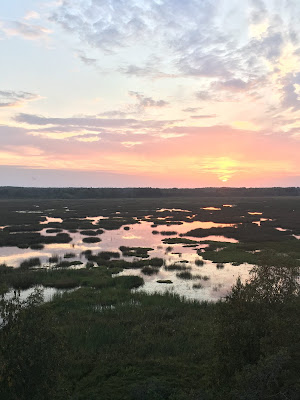
As dusk descended the real spectacle of Lake Puurijarvi revealed itself as more than 1,000 common cranes (Grus grus) returned to the mire in large sieges to rest and roost. A truly unforgettable experience.
Day Six: Visit to Lakkasuo Mire
The group visited Lakkasuo Mire, one of the principal study areas of the research project SUOSILMU (Carbon Cycling and Peatlands and Climate Change) with our host for the day, Dr Pirjo Puustjarvi. The mire receives considerable amount of groundwater from the Vatiharju esker to the west of the mire. Numerous mire site demonstration areas have been established with several kilometeres of wooden trails (or duckboards).

Three species dominate the mire habitat; Norway spruce (Picea abies), Scots pine (Pinus sylvestris) and Dwarf birch (Betula nana). Soil composition and water levels govern species dominance and the transition from Norway Spruce on better quality, drier soil to Scots pine and Dwarf birch on wetter soils was particularly obvious.

In the afternoon, we visited the Serlachius Museum in Mantta. The museum, established by Gustaf Adof Serlachius, one of the pioneers of the Finnish paper industry is aptly housed in the former head office of the company. To this day, Metsa Tissue operate a paper mill on the site of Serlachius' mill from 1868.

Day Five: Visit to Lake Puurijarvi National Park
With a free morning the group ventured into Tampere to potentially visit the world's only Moomin Museum. However some of the group were distracted by Tracon 2018, a cosplay, role-playing and anime event held in Tampere, adjacent to the Moomin Museum. I got to meet Deadpool. Chimichangas anyone?

In the afternoon we met up with our host Eveliina Asikainen who took us to Lake Puurijarvi National Park, one of the most important bird lakes in Finland. The National Park is included in the Natura 200 network as it is a Site of Community Interest (SCI) under the Habitats Directive and a Special Protection Area under the Birds Directive.

We spent late afternoon watching marsh harriers (Circus aeruginosus) patrol the mire in search of prey. I was very fortunate to see a red-backed shrike (Lanius collurio) and a white tailed eagle (Haliaeetus albicilla). All three species were firsts for me.

As dusk descended the real spectacle of Lake Puurijarvi revealed itself as more than 1,000 common cranes (Grus grus) returned to the mire in large sieges to rest and roost. A truly unforgettable experience.
Day Six: Visit to Lakkasuo Mire
The group visited Lakkasuo Mire, one of the principal study areas of the research project SUOSILMU (Carbon Cycling and Peatlands and Climate Change) with our host for the day, Dr Pirjo Puustjarvi. The mire receives considerable amount of groundwater from the Vatiharju esker to the west of the mire. Numerous mire site demonstration areas have been established with several kilometeres of wooden trails (or duckboards).

Three species dominate the mire habitat; Norway spruce (Picea abies), Scots pine (Pinus sylvestris) and Dwarf birch (Betula nana). Soil composition and water levels govern species dominance and the transition from Norway Spruce on better quality, drier soil to Scots pine and Dwarf birch on wetter soils was particularly obvious.

In the afternoon, we visited the Serlachius Museum in Mantta. The museum, established by Gustaf Adof Serlachius, one of the pioneers of the Finnish paper industry is aptly housed in the former head office of the company. To this day, Metsa Tissue operate a paper mill on the site of Serlachius' mill from 1868.


